
June 1, 2026·8 min read
When people hear “peptides,” most think weight loss. GLP-1 injections like Tirzepatide and Semaglutide have dominated the conversation for good reason-they work. But that’s only half the peptide story. There’s a quieter corner of the peptide world that athletes, biohackers, and now surgeons are using to cut recovery time in half, heal chronic injuries that seemed stuck, and rebuild tissue that traditional medicine said would take months or years.
That corner is about repair. Specifically, tissue repair at the cellular level-the kind of repair that collagen-building proteins, blood vessel formation, and cellular signaling cascades make possible. The peptides doing this work-BPC-157, TB-500, GHK-Cu-aren’t new, but they’re newly accessible, newly understood, and newly credible in spaces where trust moves slowly. Surgeons don’t typically endorse experimental biohacks. But when functional medicine doctors and orthopedic surgeons start casually recommending peptide protocols to patients post-operatively, something has shifted.
This post is about what shifted, why it matters, and what’s actually happening in your cells when you use these peptides.

Peptides like BPC-157 and TB-500 trigger cellular repair by activating growth factors, promoting angiogenesis (new blood vessel formation), and accelerating collagen synthesis. Combined as the “Wolverine Protocol,” they compress a typical 8-12 week recovery into 4-6 weeks with dramatic cost savings ($450-1,200 vs $2,400-5,400 for clinic-based PT). Real users and medical practitioners now view peptides as legitimate post-injury and post-operative tools, not fringe biohacks. The difference between GLP-1 peptides (weight loss) and tissue-repair peptides is fundamental: one suppresses appetite, the other signals your body to rebuild itself faster.
The Peptide You’ve Never Heard Of (But Surgeons Know About)
BPC-157 is a 15-amino-acid synthetic peptide that doesn’t have a snappy weight-loss story or a celebrity endorsement. What it has is multiple cellular mechanisms that activate at the exact moment tissue repair kicks in.
Here’s what happens when you introduce BPC-157 near an injury site:

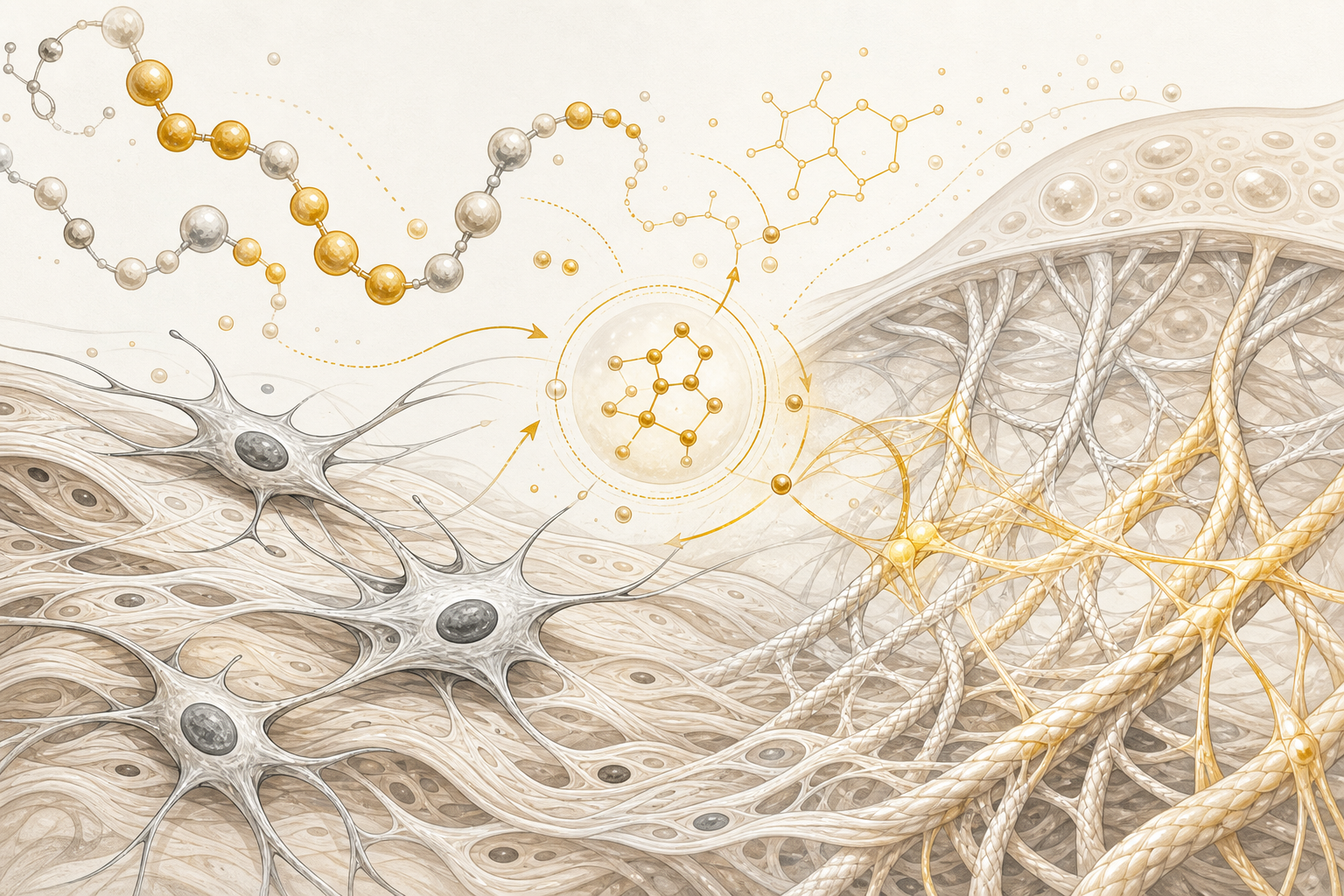
Growth Factor Signaling Activates. BPC-157 binds to growth hormone receptors and activates a protein called VEGFR2 (vascular endothelial growth factor receptor 2). This activation kicks off a cascade of intracellular signaling that tells the cell: “repair mode, now.” The cell shifts from a dormant state to an active repair state, beginning to produce the proteins and structures needed for healing.
Blood Vessels Form. BPC-157 promotes angiogenesis-the formation of new blood vessels-by increasing VEGF activity. Why does this matter? Tissue without blood supply can’t heal. New blood vessels deliver oxygen and nutrients to the injury site, accelerating the repair process. In animal models, this process is visible within days; in human users, it shows up as reduced pain and improved range of motion within 2-4 weeks.
Collagen Gets Built Fast. BPC-157 accelerates tendon and ligament repair by boosting fibroblast proliferation-fibroblasts are the cells that produce collagen. Collagen is what gives tendons, ligaments, and connective tissue their strength. Without collagen synthesis, you can’t rebuild the damaged structure. With it activated by BPC-157, the timeline compresses dramatically.
This is the mechanism side. Here’s what it actually feels like:
[One Reddit user reported: “I used the combo of BPC-157 & TB-500 and had fantastic results in a month. My elbow was so bad for 2 years that I couldn’t do any tricep work at all.” A two-year limitation resolved in one month. That’s not placebo. That’s cellular repair accelerating enough that the structural limitation goes away.
Enter TB-500: The Systemic Repair Signal
BPC-157 works well locally (near the injury), but tissue damage isn’t always localized. A torn ACL doesn’t just need repair at the tear site-the entire leg needs anti-inflammatory signaling, systemic collagen support, and nerve healing. That’s where TB-500 enters.
TB-500 is a synthetic version of thymosin beta-4, a peptide that mimics embryonic repair signals. Your body knows how to repair itself-it did it constantly in the womb. TB-500 reminds adult tissues of that embryonic repair state.
How it works:
TB-500 promotes tissue repair across multiple tissues-muscle, tendons, ligaments, and skin-by stimulating fibroblast and endothelial cell proliferation. It also exhibits potent anti-inflammatory effects, downregulating the chronic inflammation that can lock in an injury and prevent healing.
When you combine BPC-157 (local repair signaling) and TB-500 (systemic repair mobilization), you get what the community calls the “Wolverine Protocol”-a combination that’s become synonymous with accelerated recovery in athletic circles. The protocols work together: BPC-157 organizes repair at the injury; TB-500 mobilizes the entire body’s repair systems in parallel.
How Pathway to Peptides Structures the Wolverine Protocol
The Wolverine Protocol through Pathway to Peptides combines pharmaceutical-grade BPC-157 and TB-500, compounded in U.S. licensed 503A pharmacies. The modular approach is critical here-you’re not buying a three-month package that includes growth hormone support, nervous system tools, and hydration tech. You’re choosing exactly what you need.
The intended use cases tell the story:
- Athletic recovery: Accelerated healing from training-induced muscle damage, tendon strain, and ligament injuries
- Post-surgical recovery: ACL reconstruction, rotator cuff tears, surgical repairs where speed matters
- Chronic tendinopathy: Joint pain and connective tissue limitations that have been stuck for months or years
- Gut healing: BPC-157 was originally identified in gastric secretions and shows particular efficacy in gastrointestinal mucosa repair-reducing inflammation and restoring barrier function
The timeline from discovery to porch looks like this: Free consultation where you describe the injury ? Physician review of your health history ? Peptides compounded in a licensed pharmacy ? Delivered to your door within 1-2 weeks. No waiting lists. No insurance friction. No one-size-fits-all protocol.
What Users Actually Experience (From Reddit to Surgeons)
The community consensus matters here because long-term studies on humans are still limited. Real user timelines from r/Peptides, r/Biohacking, and r/CrossFit paint a consistent picture:
Weeks 1-2: Minimal acute effects. Users often feel nothing. This is normal-the peptides are signaling repair cascades, not producing immediate pain relief.
Weeks 2-4: Pain reduction becomes noticeable, particularly in targeted injection sites. Users report less ache and better recovery between workouts. Inflammation markers often drop measurably.
Weeks 4-8: Range-of-motion improvements accelerate. Previously restricted movements become possible again. Return to training becomes realistic.
Months 2-3+: Structural improvements solidify. Tendon and ligament strength increase. Mobility normalizes. Users who’ve been sidelined for months return to activities they thought were gone.
One user summed it up: “After a few weeks I noticed less ache and better recovery between workouts. The science on humans is definitely limited though.” That last sentence matters-users aren’t claiming miracle cures. They’re claiming reliable, measurable improvements with an honest acknowledgment of what we don’t yet know.
The surgeon perspective is quieter but notable. Orthopedic surgeons and functional medicine doctors increasingly integrate peptides into post-operative protocols-not as replacements for surgery, but as accelerators of post-operative healing. When a surgeon who’s spent years in the evidence-based camp casually recommends peptides to a patient, the landscape has shifted.
The Economics: Peptides vs Traditional Recovery
The time compression is one story. The cost advantage is another.

A three-month peptide protocol through Pathway to Peptides typically costs $450-1,200. Clinic-based physical therapy for the same injury runs $2,400-5,400. That’s a 50-75% cost difference for equivalent or better outcomes in terms of timeline.
Add in insurance friction: traditional PT requires pre-authorization, deals with in-network / out-of-network limits, and can get denied for a hundred reasons. Pathway’s direct-to-consumer model eliminates that friction-no insurance trail, no waiting for approval.
Add in access speed: traditional physical therapy often carries a 4-12 week waiting list to see a therapist. Pathway’s model delivers peptides within 1-2 weeks of your initial consultation.
The comparison isn’t “peptides replace PT.” It’s “peptides compress the recovery timeline and reduce friction while you’re doing it.” Many athletes use both-peptides for cellular-level acceleration, PT for mechanical strengthening. The two work in parallel.
GHK-Cu and Sermorelin: Beyond Tissue Repair
The Wolverine Protocol is the headline, but Pathway offers complementary repair tools:
GHK-Cu copper peptides support collagen production and tissue remodeling across skin, bone, lung, liver, and connective tissue. Users pairing GHK-Cu with BPC-157 report synergistic collagen synthesis-BPC-157 initiates repair; GHK-Cu amplifies collagen maturation and crosslinking.
Sermorelin and Ipamorelin (The Youth Signal) stimulate the pituitary to produce endogenous growth hormone rather than suppressing it like synthetic HGH. This matters because growth hormone is the primary repair hormone released during deep sleep. Boosting it naturally supports collagen synthesis across all tissues and enhances recovery from training.
The modular approach shines here: if your goal is collagen support for skin and systemic repair, you grab GHK-Cu. If you’re chasing growth hormone optimization for sleep and muscle tone, you grab Sermorelin. You’re not paying for a bundled package you don’t need.
Try Pathway to Peptides
Pathway to Peptides positions itself as the alternative to traditional medicine’s gatekeeping. No contracts. No forced bundles. No waiting lists. Founder Shannon Harrell-a 20+ year fitness coach and cancer survivor who’s lived the transformation she coaches others through-leads both the clinical side (physician oversight) and the coaching side (personalized guidance on implementation).
The model works because it acknowledges a truth traditional medicine often doesn’t: people don’t want to wait six months to see a specialist, jump through insurance hoops, and pay $5,000 for physical therapy. They want direct access, clear options, and coaching that respects their intelligence. Pathway delivers all three.
If you’re recovering from an injury, post-surgery, or dealing with chronic tendinopathy that’s refused to budge, the Wolverine Protocol is worth exploring. If you’re chasing systemic repair-stronger connective tissue, faster recovery from training, age-related tissue decline-the combination of GHK-Cu and growth hormone support is worth understanding. The research is there. The user reports are consistent. The practitioners using it span from biohackers to surgeons. That’s a shifted landscape.
Leave a Reply